 Crahift
£1,340 to £1,520, five weeks
A touring bike for six weeks away
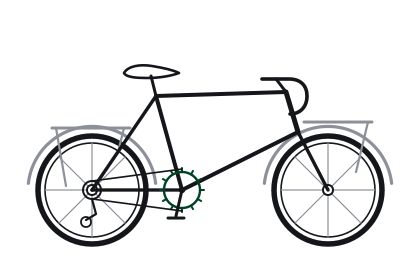
Built for six weeks of carrying everything the rider owned, with one rule above all others: every part had to be fixable at the side of a road with the tools in the saddlebag.
 £1,340 to £1,520
 Five weeks
The brief
Six weeks, roughly 2,000 miles, camping most nights, carrying about eighteen kilos of luggage. The rider was not fast and did not want to be. They wanted to arrive.
The brief they gave us was one sentence and it shaped every decision: if it breaks, I need to be able to fix it myself, in a lay by, in the rain.
That single constraint is why this bike looks twenty years out of date, and why we would build it exactly the same way again.
What we chose, and why
Bar end shifters with a friction mode
This is the most important part on the bike. Indexed shifting is lovely until a cable frays or a hanger bends, and then you have a bike stuck in one gear. These shifters have a switch that turns indexing off and lets you move the derailleur by feel.
It means a bent hanger becomes an inconvenience instead of the end of the trip. The rider used it once, in week four, and it saved two days.
Rim brakes, not hydraulic discs
We had this argument properly. Discs stop better, especially loaded and wet, and we fit them happily on other bikes. But hydraulic brakes need fluid, a bleed kit and clean hands, and pads are not something you find in a village.
Cantilever brakes with cartridge pads stop a loaded bike perfectly well, and spare pads are the size of a matchbox. The rider carried four sets and used two.
Wheels built to be over engineered
36 spokes front and rear, three cross, brass nipples rather than alloy, and tension deliberately on the high side. Loaded touring wheels do not fail dramatically, they fail slowly, one spoke at a time.
We taped four spare spokes to the chainstay where they are out of the way and impossible to forget. One broke in week five and was replaced in twenty minutes. Both wheels came back still true, which is the only wheel review that matters. This is our wheel building at its most cautious.
A triple chainset, because pride is heavy
A wide range triple with a very low bottom gear. Loaded, on a long climb, at the end of a day, you want a gear that lets you spin slowly rather than one that makes you push. We geared it lower than the rider thought they needed and they told us afterwards it was the right call.
A dynamo hub, and a charger
Lights that never need charging, and a USB output that kept a phone alive between towns. On a trip where you are camping, being able to charge without a socket is worth more than the weight.
Steel racks, bolted properly
Front and rear steel racks. Aluminium racks are lighter and crack; steel ones bend and can be bent back or welded in any town. We fitted them with stainless bolts and a smear of grease so they would come off again after six weeks of road salt.
What it cost
Parts came to £800 to £980, the range depending mostly on the frame and the dynamo hub. Our labour was £280 for the build, plus £260 for the pair of hand built wheels at our usual £130 a wheel.
Total, £1,340 to £1,520. It is a lot of money. It is also a bike that came back from six weeks needing one spoke and a chain, and which the rider still uses daily four years on.
How long it took
Five weeks, and only two of those were work. The rear rack took eleven days to arrive and the frame came to us from a painter running late.
We built both wheels while we waited, which is the right order. Wheels are the part you least want to rush and the part that most benefits from sitting for a day between tensioning sessions.
What we would tell the next person
Decide what you are optimising for before you look at a single part. This rider wanted repairability and we built the whole bike around that one word. Somebody wanting speed would have got a completely different and equally defensible bike.
The other thing: carry spare spokes, and tape them to the frame rather than putting them in a bag. Every touring cyclist we have built for who carried spares has used them.
If you are riding mixed surfaces rather than roads, the budget gravel build goes through the tyre reasoning in more detail.
Where to go next
The bare frame commuter
Another one written out in full, with the parts and the reasoning.
Go there Service
Custom builds
What we include, what we do not, and what it costs.
Go there
Contact
Start a conversation
Tell us the brief and we will tell you honestly if we are the right workshop.
Go there