 Crahift
£280 to £330, nine days
A single speed on a student budget
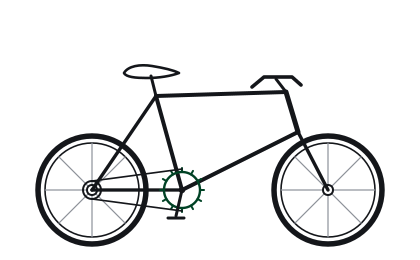
Three hundred and fifty pounds, all in, no exceptions. A flat city, a bike that needs almost nothing doing to it, and one thing we refused to leave off no matter what it did to the budget.
 £280 to £330
 Nine days
The brief
A student with £350 and a very clear head about what they wanted. Flat city, two miles each way, a bike that would live locked up outside and would not be a tragedy if it went missing.
They came in with a set of wheels and a seatpost from a bike that had been hit by a car, and asked whether anything could be built around them.
The honest answer to a budget like this is usually "buy something second hand". We said so first. They had already looked, everything decent was going for more than £350, and they wanted something they understood well enough to maintain.
What we chose, and why
Their wheels, trued rather than replaced
The wheels were the whole reason this worked. They were dented at the rim on the rear but structurally fine. We trued and re tensioned both, replaced two spokes, and fitted new rim tape. That is £36 of truing, which we folded into the build labour rather than charging on top, instead of £200 of new wheels.
Reusing what somebody already has is the single biggest lever on a budget build, and it is the first thing we look at.
A second hand frame from our own stock
We keep a small rack of frames that came off bikes not worth repairing. A steel frame with horizontal dropouts, which is what a single speed needs to get the chain tension right, came out of that pile for very little.
Both brakes, and this was not negotiable
They asked about running it with one brake, or none, because that is the look. We will not build that. It is not a moral position, it is that a bike with one brake in traffic has no redundancy, and we would be the people who put it on the road.
We fitted new pads and cables to a pair of second hand calipers. It cost about £30 of the budget and it was the least negotiable £30 on the bike.
Freewheel, not fixed
We fitted a flip flop hub so they can switch later if they want to, but we set it up freewheel and told them why. Riding fixed is a skill and learning it in city traffic on your only bike is a poor plan. The option is there when they want it.
Where we spent the money that was left
New chain, new freewheel, new bottom bracket, new cables, new tyres, new grips. All the wearing parts, none of the visible ones. The saddle and bars are second hand and perfectly good.
A new chainset would have looked better and done nothing. We talked them out of it and put the money into tyres, which is where it always belongs.
What it cost
Parts came to £140 to £190, most of that in tyres, the chain and the freewheel. Our labour was £140, which is half our usual build charge because there was so little to do once the wheels were sorted.
Total, £280 to £330. That left them between twenty and seventy pounds of the budget, and we told them to put every penny of it into a lock before they bought anything else.
How long it took
Nine days, and seven of those were waiting for a freewheel. The build itself was an afternoon and the wheel work was a morning.
What we would tell the next person
Tell the workshop your total budget at the start, including the number you are embarrassed by. We can build a good bike to almost any number if we know what the number is. What we cannot do is design a £600 bike and then take £250 of parts off it and still have it be coherent.
Bring anything you already own, even if it looks broken. Wheels especially. A dented rim is often fine and a wheel that can be trued is £200 you do not have to spend.
And spend what is left on tyres and a lock, in that order. Nobody has ever regretted either.
Where to go next
The bare frame commuter
Another one written out in full, with the parts and the reasoning.
Go there Service
Custom builds
What we include, what we do not, and what it costs.
Go there
Contact
Start a conversation
Tell us the brief and we will tell you honestly if we are the right workshop.
Go there